
Explore English
Everyday British Expressions and Idioms
Understand everyday idioms for feeling unwell, getting nervous, changing your mind and relaxing.
Accessibility options
Four idioms you can use in conversation
These examples are adapted from Katie Pirsoaga’s Idiom Adventures. An idiom is a phrase with an established meaning that may be hard to guess from its individual words.
| Idiom | What it means | Example |
|---|---|---|
| Feel under the weather | Feel slightly unwell | “I’m feeling a bit under the weather, so I’ll stay in tonight.” |
| Have butterflies in your stomach | Feel nervous or excited before something | “I had butterflies in my stomach before my first lesson.” |
| Have a change of heart | Change how you feel about something or reconsider a decision | “I was going to cancel the trip, but I’ve had a change of heart.” |
| Let your hair down | Relax and enjoy yourself after a period of work or restraint | “After a busy week, it was lovely to let our hair down.” |
A note on wording
You can change the tense or possessive to suit the speaker. Try “She had butterflies in her stomach” or “They let their hair down after the exam.” The other words generally stay together.
You may also hear casual British expressions such as fancy a cuppa? (would you like some tea?) and I’m knackered (I’m very tired). Both suit informal conversation.
Quick check
You planned to turn down an invitation, but now you’d like to go. Which idiom describes the change?
Show the answer
“I’ve had a change of heart.” Your feelings or decision have changed.
Use it yourself
Tell a short story about a time you felt nervous before doing something for the first time. Use butterflies in my stomach, then explain how you felt once you got started.
From Idiom Adventures
Introduction to Idioms - The Heart of Language
Definition and Explanation of Idioms
In the fascinating tapestry of language, idioms emerge as distinctive and colorful threads, weaving together meaning in ways that transcend the literal. An idiom is a unique phrase in which the collective meaning of the words is different from their individual dictionary definitions. For example, the idiom "break the ice" doesn’t literally pertain to fracturing ice. Instead, it metaphorically describes the act of easing social tension or initiating a conversation in a new or awkward situation.
The beauty of idioms lies in their metaphorical nature, often painting vivid pictures or telling mini-stories. They add depth, humor, and imagination to language, a quality not typically found in straightforward, literal expressions. Take, for instance, "spill the beans," which has nothing to do with actual beans but means to reveal a secret. Or consider "when pigs fly," an amusing way to indicate that something is highly unlikely or impossible.
Understanding idioms is crucial for anyone delving into a new language. They offer windows into the cultural, historical, and social fabric of a community. Idioms often encapsulate the collective experiences, values, and beliefs of a culture. For instance, "kick the bucket," a light-hearted way of referring to death, reflects a certain cultural attitude towards the topic. Similarly, "bite the bullet," meaning to endure a painful experience without fear, tells a story of courage and resilience.
Learning idioms allows language learners to grasp more than just grammar and vocabulary; it enables them to dive deeper into the cultural nuances and historical underpinnings of a language. It's a journey into the heart of communication, where language is not just a tool for expressing thoughts but a rich, cultural tapestry that connects individuals across time and space.
Grammatical Usage of Idioms
The grammatical structure of idioms is as diverse and complex as the idioms themselves.
Understanding their grammatical usage not only enhances comprehension but also aids in their effective application in language.
Chapter 1: Navigating Nature's Language
In this chapter, we dive into the fascinating world of British English idioms that draw inspiration from the natural world.
These expressions offer a glimpse into how our ancestors perceived and interacted with the environment around them.
Let's explore a handful of idioms that have stood the test of time.
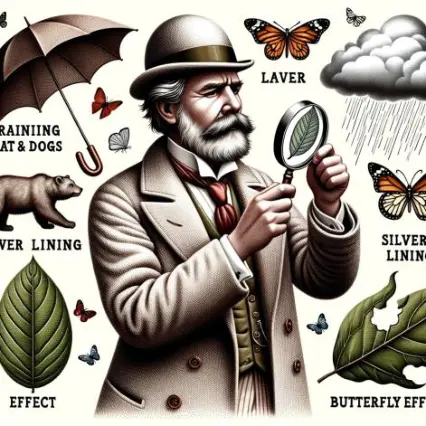
Raining cats and dogs
- Definition: Used to describe heavy or torrential rain.
- Grammar: Present continuous tense.
- Origin: We kick off with a classic: "Raining cats and dogs." While the origin of this phrase remains shrouded in mystery, it's believed to have emerged in the 17th century. This colorful idiom vividly depicts heavy rain, suggesting a torrential downpour beyond the ordinary. It's like imagining the sky unleashing an entire menagerie of animals. A whimsical notion, indeed!
- Example: "I can't believe we're stuck outside in this weather! It's raining cats and dogs!"
Hold your horses
- Definition: A request for someone to be patient and wait before taking action.
- Grammar: Imperative form.
- Origin: "Hold your horses" is another gem. This equestrian-inspired phrase dates back to the days of horse-drawn carriages and serves as a gentle admonishment to be patient and not rush into things. Think of it as an ancient version of "take a breather." Its roots likely stem from the need to control horses before setting off, ensuring a safe and steady journey.
- Example: "Hold your horses! Let's think about this before making a decision."
Make hay while the sun shines
- Definition: Take advantage of an opportunity while it lasts.
- Grammar: Imperative form.
- Origin: "Make hay while the sun shines" paints a vivid agricultural picture. In a time when manual labor ruled the fields, the importance of seizing favorable weather conditions for haymaking was crystal clear. This adage still encourages us to seize opportunities promptly, just as farmers would maximize sunny days for their harvest.
- Example: "The job market is booming right now. You should make hay while the sun shines and apply for as many positions as possible."
Under the weather
- Definition: Feeling unwell or sick.
- Grammar: Adjective phrase.
- Origin: Feeling a bit "under the weather"? This expression draws parallels between our emotional state and the unpredictable elements. Originating from seafaring contexts, "under the weather" referred to being in a vulnerable or uncomfortable position on a ship due to rough seas. Over time, the phrase transformed to represent someone feeling less than their best.
- Example: "I won't be able to make it to the meeting today; I'm feeling a bit under the weather."
When pigs fly
- Definition: Used to express that something will never happen.
- Grammar: Future tense with a conditional clause.
- Origin: Ah, "when pigs fly." A whimsical way to express disbelief or the unlikeliness of a situation. Though its exact origin isn't documented, this idiom's imagery is clear – pigs soaring through the skies is a playful representation of the improbable. But who knows? In the world of idioms, anything is possible!
- Example: "Sure, I'll clean my room when pigs fly."
Idiom Adventures
The online guide above is free. This optional PDF edition is sold separately.
The full 38-page PDF explores idioms about nature, the body, emotions and celebrations.
Practise with Choose the Natural Expression →
Related resources
Book a session
Practise speaking in a real conversation or prepare for an interview with Katie.
Book a Session →