Explore English
Past Simple vs Present Perfect
Choose a finished past time or a connection to now, including advanced contrasts and regional usage.
Accessibility options
Choose what the listener needs to know
Past simple locates an event in a finished past period: I sent the update yesterday. Use did + base verb in ordinary questions and negatives: Did you send it? I didn’t send it.
Present perfect uses have/has + past participle. Use it for life experience, time up to now or a current result: Have you ever worked remotely? We’ve had three calls today. I’ve lost my keys.
- Finished period: I saw her last week.
- Unfinished period: I’ve seen her twice this week.
- Experience followed by detail: Have you ever run a workshop? Yes, I ran one last March.
- Continuing state: I’ve lived here since 2022. Compare I lived there for two years if the period is over.
- Result now: I’ve left my badge at home helps explain why you cannot get in. I left it at home this morning gives the finished time.
This morning, today and this week
The same words can take either form depending on the speaker’s perspective. At 10 a.m., I’ve answered three emails this morning counts up to now. At 3 p.m., I answered three emails this morning treats the morning as finished. Even in an open period, I spoke to Lee at nine today focuses on a completed event at a definite time.
Just, already, yet, ever and never
I’ve just arrived, She’s already replied, Have they arrived yet? and I’ve never tried it are natural British English patterns. American English often uses the past simple with just, already and yet, for example Did they arrive yet? Both varieties use both tenses.
When choosing between a result and the activity leading to it, see Present Perfect Simple vs Continuous.
Quick check
Complete the conversation: “Have you ever ___ (give) a presentation in English?” “Yes, I ___ (give) one last Monday.”
Show the answers
Given, then gave. The opening question asks about experience, and the reply names a finished time.
Use it yourself
Ask someone three “Have you ever…?” questions. For each yes, ask “When did you…?” and get one more detail in the past simple.
Continue the lesson
Session Overview
- Structure
- Usage
- Finished vs unfinished time
- Life experience vs completed actions
- Common learner mistakes
- British vs American usage
- Natural conversation patterns
- Advanced nuance and meaning changes
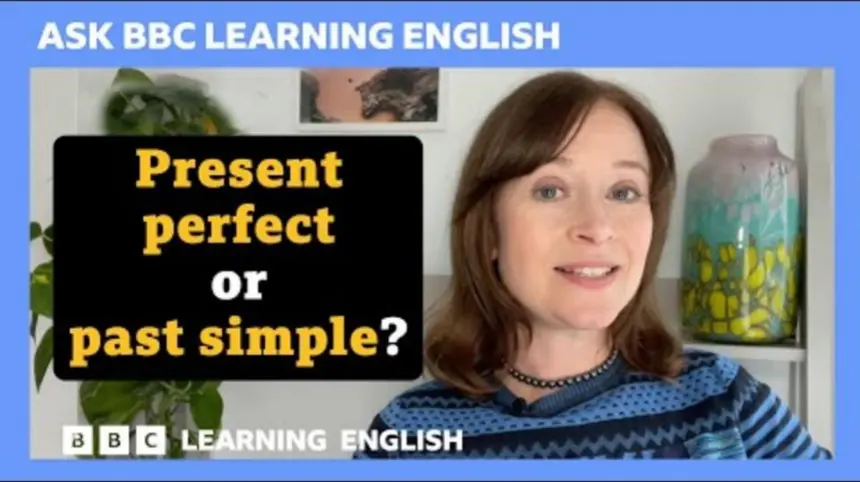
Let’s watch
ASK BBC LEARNING ENGLISH Present perfect y past simple? | IGLISH
Past Simple — Structure
Positive Subject + past verb
Time markers
- Yesterday
- Last week
- In 2023
- Ago
- During…
- When I was…
I worked remotely last year.
She visited Paris in 2024.
We deployed the update yesterday.
Negative Subject + did not + base verb
I didn’t attend the meeting.
They didn’t finish the sprint.
Questions Did + subject + base verb?
Did you test the API?
Did she reply to the client?
Present Perfect — Structure
Positive Subject + have/has + past participle
Time markers
- Already
- Yet
- Just
- Ever
- Never
- Recently
- Lately
- Since
- For
- So far
I have worked remotely since 2020.
She has attended several conferences.
We’ve already deployed the update.
Negative Subject + have/has not + past participle
I haven’t finished yet.
He hasn’t replied.
Questions Have/Has + subject + past participle?
Have you tested the system yet?
Has she submitted the paper?
Usage
Past Simple
- Finished actions
- Completed past events
- Actions at a specific past time
- Sequences in stories
- Historical facts
Present Perfect
- We use the Present Perfect for:
- Life experience
- Unfinished time
- Actions connected to now
- Recent results
- Changes over time
Examples
Examples
I attended a conference in Athens last year.
I’ve worked with international clients.
She’s already submitted the abstract.
We’ve improved the website a lot.
Have you ever used Docker?
We fixed the bug yesterday.
She called me this morning.
They finished the project in April.
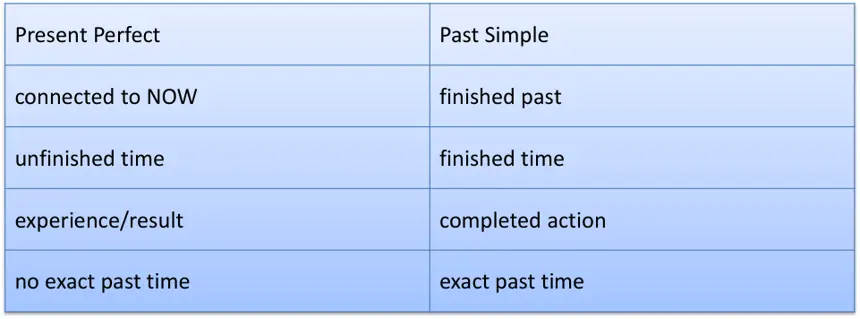
The BIG Difference
| Present Perfect | Past Simple |
|---|---|
| connected to NOW | finished past |
| unfinished time | finished time |
| experience/result | completed action |
| no exact past time | exact past time |
Examples
I’ve visited Paris.
(The experience matters)
I visited Paris in 2023.
(The finished time matters)
Finished vs Unfinished Time
Finished Time → Past Simple
yesterday last year in 2022 two days ago
Example:
I spoke to the client yesterday.
Unfinished Time → Present Perfect
today this week recently so far
Example:
I’ve spoken to three clients today.
Timeline Visual
Present Perfect Past → NOW
Past Simple Past → Finished I worked remotely during lockdown.
(The action is finished and separated from now)
I’ve worked remotely since 2020.
(The action started in the past and continues or matters now)
Present Perfect
Past → Finished
Past → NOW
- The action:
- continues now OR
- affects now OR
- matters now
The action:
- is complete
- has no active connection to now
- belongs to a finished time period
Life Experience
We often use the Present Perfect for experiences.
When we talk about life experience:
- the experience itself is important
- NOT the exact time
Example
I’ve been to Hong Kong.
The speaker wants to communicate:
“I have this life experience.” The exact year is not important.
Examples
Have you ever worked abroad?
I’ve never been to Hong Kong.
She’s presented at international conferences.
Then contrast:
I went to Hong Kong in 2023.
But…
Now the focus changes:
- specific event
- specific finished time
When have you gone there?
When did you go there?
Why?
Because:
“when” = specific finished past time
Specific Time = Past Simple
Finished time words kill the Present Perfect
Examples
I have visited Paris last year.
I visited Paris last year.
She has called me yesterday.
She called me yesterday.
Finished Time Expressions
- Yesterday
- Last week
- In 2020
- Ago
- When I was…
- During…
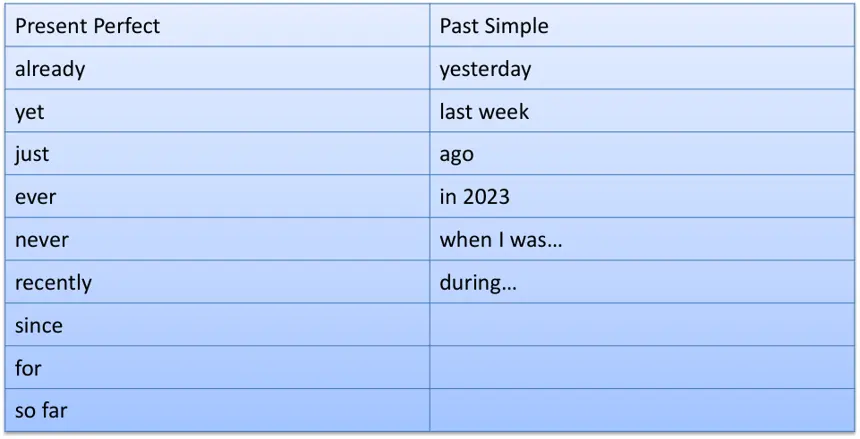
Time Expressions
Present Perfect Past Simple
already yesterday
yet last week
just ago
ever in 2023
never when I was…
recently during…
since
for
so far
Present Perfect Past Simple already yesterday last week yet just ago ever never when | was.
recently during...
since for so far
Why Both Can Sometimes Be Correct
Sometimes both tenses are grammatically possible.
The difference is:
- focus
- perspective
- communication goal NOT basic correctness.
Present Perfect Focus = result / relevance now
I’ve sent the email.
(The important thing is the result NOW)
Past Simple Focus = completed action
I sent the email this morning.
(The important thing is WHEN it happened)
British vs American Usage
| British English | American English |
|---|---|
| I’ve just finished. | I just finished. |
| Have you eaten yet? | Did you eat yet? |
| She’s already left. | She already left. |
| Have you seen John today? | Did you see John today? |
British English More likely to use Present Perfect for:
- Recent events
- Unfinished situations
- Current relevance Examples:
American English More likely to use Past Simple in informal conversation.
Examples:
I just finished.
Did you eat yet?
I’ve just finished.
Have you eaten yet?
Both forms are widely understood internationally.
Why This Confuses Learners
Students are often taught:
One is correct and one is wrong.
Reality:
Native speakers choose based on:
- Perspective
- Region
- Context
- Conversation style
- Relevance to now
FYI: The present perfect can be used in the same way in American English, but people often use the past simple when they consider the action finished. This is especially common with the adverbs already, just and yet.
FYI: Since many tech companies, media platforms, and online resources are American, learners often hear both systems mixed together.
Context Changes Meaning
I worked at Google.
→ finished employment
I’ve worked at Google.
→ life experience / relevance
She lived in Madrid for 10 years.
→ she does NOT live there now
She’s lived in Madrid for 10 years.
→ she STILL lives there now
Common Spanish Speaker Mistakes
I am here since 2020.
I have been here since 2020.
I have seen him yesterday.
I saw him yesterday.
Did you ever go to London?
Have you ever been to London?
We are finished already.
We have already finished.
Native Speaker Nuance
Native speakers do not always think consciously about grammar rules.
Instead, they often choose tenses based on:
- Emotion
- Emphasis
- Relevance
- Conversational tone
- Speed of communication
More connected to:
- Concern
- Current situation
- Result
More connected to:
- The past action itself
- Casual conversation
- Storytelling
“Have you eaten?” Focus: Are you hungry NOW?
“Did you eat?” Focus: The past action itself
Both are natural. The speaker simply chooses a different perspective.
Native Speakers “Break” the Rules
Grammar taught in classrooms is often:
- Cleaner
- Slower
- More formal
Native speakers are not “wrong”.
Language changes naturally in:
- Informal speech
- Regional dialects
- Fast conversation
- American english
- Online communication
Real spoken English is more flexible.
British English Usually prefers Present Perfect
I’ve just arrived.
Understanding WHY native
American English Often uses Past Simple
speakers choose a tense is more useful than memorising
I just arrived.
rules.
This is normal native usage.
Discussion Questions
| Area | Present Perfect | Past Simple |
|---|---|---|
| Main idea | Connected to NOW | Finished past |
| Focus | Experience, result, relevance | Completed action |
| Time | Unfinished / not specific | Finished / specific |
| Structure | have/has + past participle | past verb |
| Example | I’ve worked abroad. | I worked abroad in 2022. |
| Exact time mentioned? | Usually NO | Usually YES |
| Common question | Have you ever…? | When did you…? |
| Typical use | Life experience | Past events/details |
| Time markers | already, yet, just, ever, never, since, for, so far | yesterday, ago, last week, in 2023 |
Have you ever worked on a difficult project?
What’s the most interesting place you’ve
visited?
Did you study English at school?
Have you used AI tools recently?
What did you do last weekend?
Have you ever presented in public?
The Hidden Truth
Native speakers do not choose tenses only by
rules.
They choose them by perspective.
Recommended Practice & Resources
British Council British vs American English:
https://learnenglish.britishcouncil.org/free-resources/grammar/b1-b2/british-english-american-english Test English Present Perfect vs Past Simple:
https://test-english.com/grammar-points/a2/present-perfect-or-past-simple/ Extra Practice Perfect English Grammar:
https://www.perfect-english-grammar.com/past-simple-present-perfect-1.html
Practise with Which Tense Works? →
Related resources
Book a session
Practise speaking in a real conversation or prepare for an interview with Katie.
Book a Session →